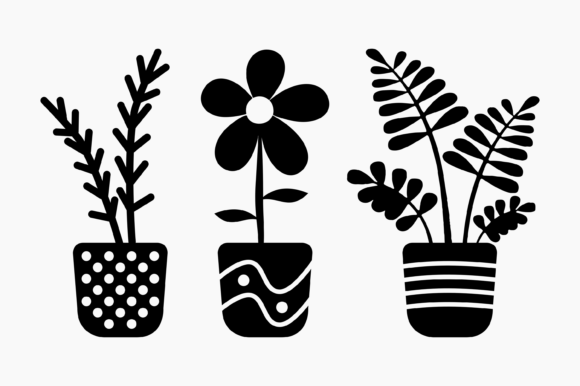
House Plants Set: Plants Silhouette
A Clean, Quiet Confidence — First Impressions That Stick
When I opened House Plants Set. Plants Silhouette., I didn’t see clutter or trend-chasing — I saw breathing room. These aren’t fussy botanicals with veins and gradients; they’re confident, simplified silhouettes — monstera, snake plant, pothos, maybe a soft fern — all drawn with quiet intention. No overlapping layers, no forced symmetry, no unnecessary curves. Just clean outer edges and thoughtful negative space. That’s gold for embroidery. It means fewer stitch jumps, smoother satin stitch transitions, and a design that reads clearly even at 3 inches tall on a baby onesie or 5 inches wide across a linen tote.
Where This Design Earns Its Keep — Real Projects, Real Feedback
Last week, I used three motifs from the set to embroider a custom organic cotton apron for a local plant shop’s staff gift. The client wanted “calm but intentional — like their space.” We chose the monstera and snake plant side-by-side near the pocket, stitched in matte olive and charcoal thread. Customers noticed it immediately. Not because it shouted, but because it *belonged*. That’s the strength of House Plants Set. Plants Silhouette.: it supports the product instead of competing with it.
It works just as well on sweatshirt cuffs (small-scale monstera leaf), tea towel hems (a single trailing pothos), or nursery pillow covers (three tiny plants arranged in a gentle arc). As an Etsy seller, I’ve listed embroidered patches made from these silhouettes — they stitch cleanly at 2.2” with minimal fraying, hold up through repeated washing, and photograph beautifully against neutral backdrops. For craft business owners, this is low-risk, high-recognition design work: customers recognize the theme instantly, trust the handmade quality, and connect emotionally with the quiet warmth of indoor greenery.
Fabrics & Surfaces: Where It Shines — and Where to Pause
House Plants Set. Plants Silhouette. thrives on stable, medium-weight fabrics: canvas totes, midweight cotton tees, twill caps, linen pillow covers, and denim jackets. On those, the silhouette clarity translates directly into stitching clarity — clean fill stitches, crisp satin borders, no “fuzzing” at the edges.
Use caution on: stretchy knits (pre-stabilize heavily — consider cutaway + tear-away combo), very thin voile or rayon (risk of puckering or show-through), dark fabrics with light thread (check contrast in your mockup — some silhouettes lose definition if scaled too small), and curved surfaces like cap fronts (test hoop placement early — the longest motif may need repositioning). Also avoid cramming more than two elements onto a baseball cap’s front panel — the spacing needs air to read as intentional, not cramped.
Design Integrity in Motion — Why Clarity Builds Trust
Customers don’t buy “a plant design.” They buy confidence — that the item feels considered, cohesive, and authentically handmade. House Plants Set. Plants Silhouette. delivers that because its simplicity isn’t lazy — it’s curated. There’s no visual noise to distract from the texture of the fabric or the care in the stitching. When someone receives a personalized gift with one of these motifs, they feel the thought behind it. That builds repeat business, social shares, and word-of-mouth referrals — especially for boutique branding or wedding favors (think: mini embroidered towels for a “green” bridal shower).
For digital product sellers, these are strong design assets. They scale cleanly for printable mockups, pair effortlessly with minimalist typography in Canva or Illustrator, and translate well into sublimation or heat-transfer workflows — making them versatile beyond just machine embroidery design use.
Practical Embroidery Designer Notes — Before You Stitch
- Always test first: Run a sample on scrap fabric matching your final project’s weight and stretch — especially for baby embroidery or holiday embroidery where durability matters.
- Check thread color contrast: A dark silhouette on navy denim reads differently than on oatmeal linen. Try black, charcoal, forest green, and cream — then photograph both light and dark versions.
- Review stitch density: Simpler silhouettes often mean lower stitch counts — great for speed and fabric breathability — but confirm no areas look sparse or overly dense in your embroidery software.
- Confirm hoop size and placement: Measure the largest motif against your standard hoop. If it’s tight, adjust layout or choose a smaller variant from the set.
- Inspect fine details: Zoom in on corners and inner curves — do they hold shape? Are there any micro-gaps that might snag thread?
- Mock it in black and white: This reveals value contrast issues faster than color previews — essential for custom apparel and embroidered patch consistency.
- Match stabilizer to fabric: Cutaway for knits, tear-away for stable wovens, fusible for lightweight linens. Don’t skip this step — it’s what makes the finished product look professional, not homemade.
- Verify licensing for commercial use: Since this is a digital embroidery file marketed for unlimited use, double-check the seller’s terms before selling finished products or bundling into your own craft business kits.
Final Thought: Less Is Anchored, Not Empty
House Plants Set. Plants Silhouette. doesn’t try to be everything. It’s not a floral explosion, a maximalist collage, or a hyper-realistic rendering. It’s a focused, calm, and deeply usable collection of graphics — rooted in craft sensibility, not algorithmic trends. Whether you’re stitching a single leaf on a child’s bib or building a full line of nursery decor, this set gives you room to breathe, time to refine, and a result that feels quietly confident. In a world of visual noise, that kind of restraint is rare — and reliably valuable.