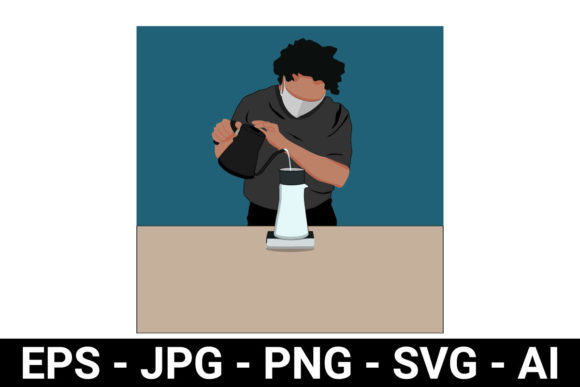
Flat Character Barista Wearing a Mask
A Design That Feels Like a Warm, Quiet Moment in a Coffee Shop
When I first opened the Flat Character Barista Wearing a Mask vector ZIP folder, I didn’t just see an illustration—I saw a mood. Clean lines, soft posture, gentle hands cradling a mug, and that subtle, respectful mask covering the lower face. It’s not clinical or urgent; it’s calm, capable, and quietly human. As someone who’s stitched hundreds of character-based designs for small-batch apparel and boutique kitchen goods, I immediately pictured this on a linen tea towel—embroidered in muted oat and charcoal thread, with just enough detail to read clearly at 3 inches tall but not so much that it fights the fabric grain.
Where This Design Truly Shines in Real Embroidery Projects
The Flat Character Barista Wearing a Mask works best where personality meets practicality. I recently used a version of it (after converting the SVG to a machine embroidery design) for a set of custom aprons for a local roastery’s staff gifts. The flat style translated beautifully: no tricky gradients, no fine facial features that vanish under satin stitch, and a clear silhouette that reads even at modest sizes. It also held up well on midweight cotton twill—no puckering, no thread nesting—because the original vector’s clean geometry gave me room to adjust stitch density without losing shape.
This is especially valuable for small shop products like embroidered tote bags, baby onesies, or pillow covers meant for nursery decor. On a soft organic cotton onesie, the simplicity kept the focus on craftsmanship—not on fighting stray stitches. And because the character faces forward with open, approachable body language, it feels warm and inclusive, not dated or overly themed. That matters when you’re selling personalized gifts or building brand consistency across a line of handmade products.
Where to Proceed Thoughtfully—Not With Caution, But With Intention
Like any good illustration, the Flat Character Barista Wearing a Mask isn’t magic—it’s a tool. And tools need context. Its clean lines make it adaptable, but don’t assume it’ll auto-fit every surface. On curved areas like caps or structured hats, I recommend testing the layout in a printable mockup first—especially the arms and mug handle, which sit close to the edge of the character’s frame. Those thin negative spaces can compress or distort if hooped too tightly.
For dark fabric, check contrast early: the original PNG and JPG files include transparent backgrounds, but your thread colors must carry the visual weight. A light beige fill stitch might disappear on navy denim unless backed with a stabilizer that adds slight lift—or swapped for a cream or oat tone with higher chroma. Likewise, on stretchy fabric like knits or lightweight sweatshirts, use cutaway stabilizer, not tear-away. The design’s balanced proportions rely on stability, not fabric give.
And while the vector includes AI and EPS files—ideal for scaling—the embroidery file you generate will behave differently at 2 inches versus 5 inches. Tiny details like the steam curl above the mug? They’re charming in print, but may need simplification or conversion to a running stitch for reliable machine embroidery at sub-2-inch sizes.
What This Design Says—Before You Even Stitch a Single Thread
Your customers notice tone before technique. The Flat Character Barista Wearing a Mask doesn’t shout “coffee shop”—it whispers “care,” “craft,” and “everyday ritual.” That builds customer trust in a way busy, hyper-detailed illustrations often don’t. It looks intentional, not algorithmic. That’s why it’s strong for Etsy sellers offering personalized gifts: it feels handmade even before stitching begins.
I’ve seen similar designs fall flat on holiday merchandise because they lean too hard into seasonal tropes—but this one sidesteps that. It’s equally at home on a Valentine’s Day mug sleeve as it is on a back-to-school teacher gift. That versatility boosts product value and extends shelf life across your craft business inventory.
Practical Notes from My Hoop to Yours
- Always test on scrap fabric first—especially if using textured weaves or blends. The flatness of the character can emphasize fabric irregularities.
- Review stitch density before finalizing. Too dense, and the design stiffens; too sparse, and the mug or hands lose definition. Aim for 8–12% fill in key shapes.
- Confirm hoop size early. The composition fits comfortably in a 4×4 hoop at 3.5 inches—but stretch that to 5 inches, and arms or mug base may clip unless adjusted.
- Inspect small details in both black-and-white and color mockups. Does the mask read clearly? Does the hand holding the mug feel anchored, not floating?
- Check licensing before listing finished items or digital embroidery assets. Since this is categorized as Graphics, verify commercial use rights if selling embroidered patches or digital embroidery files.
- Use proper stabilizer—especially for applique design versions or layered garments like reversible aprons.
Final Thought: It’s Not Just a Barista—It’s a Vibe You Can Stitch
The Flat Character Barista Wearing a Mask isn’t about nostalgia or trend-chasing. It’s about presence. When stitched cleanly on a kitchen towel or embroidered patch, it says, “I pay attention—to craft, to care, to quiet moments.” That resonance is rare in Illustrations meant for real-world making. Whether you’re prepping for a craft fair, building a small shop product line, or designing a limited-run collection for a café client, this design earns its place—not because it’s easy to digitize, but because it holds space for meaning. And in handmade work, that’s the detail that stitches last.